
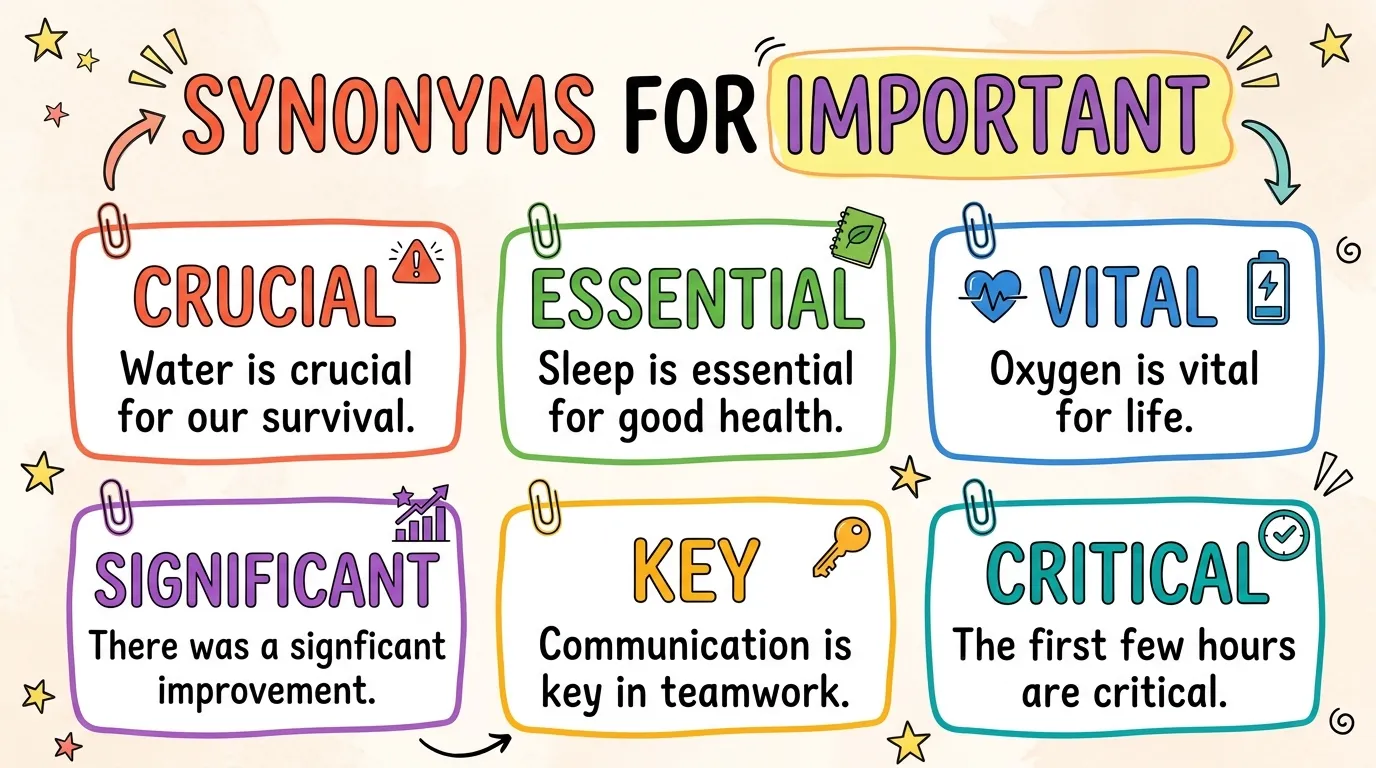
The best synonyms for important are significant, essential, crucial, vital, key, major, and main. Which one you choose depends on how important something is. Use essential or vital when you cannot do without it, crucial when it decides the result, significant when it has a big effect, main or primary when it comes first, and influential when you describe a person. Below are 40 synonyms for important, grouped by meaning, each with a tone label and a real example sentence.
Quick Answer: 10 Best Synonyms for Important
- Significant – having a big effect or meaning
- Essential – absolutely necessary
- Crucial – deciding whether something succeeds or fails
- Vital – necessary for life or success
- Key – very important; central to something
- Major – large and serious
- Main – the most important of several
- Critical – extremely important at a decisive moment
- Fundamental – forming the base of everything else
- Influential – having power over people or events (for people and ideas)
Before and After: How One Word Makes Your Writing Clearer
“Important” is not wrong, but it is very general. Notice how each sentence becomes more precise:
| Before (general) | After (precise) |
| Water is important for all living things. | Water is vital for all living things. |
| This is an important step in the process. | This is a crucial step in the process. |
| The war had an important effect on the economy. | The war had a significant effect on the economy. |
| Price is the important reason people choose this phone. | Price is the main reason people choose this phone. |
| She is an important scientist in her field. | She is a prominent scientist in her field. |
| Please reply soon. This is important. | Please reply soon. This is urgent. |
| Teamwork is an important part of success. | Teamwork is a key part of success. |
| These photos are important to me. | These photos are precious to me. |
Synonyms for Important by Meaning
Before you replace “important,” ask: “Important in what way?” Then choose from the matching group. Tone labels show where each word fits: formal (essays, reports, IELTS), neutral (almost anywhere), or informal (speaking and casual messages).
1. Important Because It Has a Big Effect or Meaning
| Word | Meaning | Tone | Example |
| Significant | large or important enough to have an effect | neutral / formal | There has been a significant rise in food prices this year. |
| Major | very large or serious | neutral | Climate change is a major problem for coastal cities. |
| Meaningful | important and full of purpose | neutral | Volunteering gave her life a meaningful direction. |
| Notable | worth noticing or mentioning | formal | One notable exception is the city’s public transport system. |
| Momentous | very important because of future effects | formal | Landing on the moon was a momentous event in human history. |
| Historic | so important it will be remembered in history | neutral / formal | The two countries signed a historic peace agreement. |
| Landmark | marking an important change or turning point | formal | The court made a landmark decision on equal pay. |
Near-match note: Historic means important in history. Historical simply means connected with the past. “A historic win” is a famous victory; “a historical novel” is a story set in the past.
2. Important Because You Need It (Necessary)
| Word | Meaning | Tone | Example |
| Essential | completely necessary | neutral / formal | Sunscreen is essential on a beach vacation. |
| Vital | necessary for life, success, or survival | neutral / formal | Regular check-ups are vital for good health. |
| Crucial | deciding whether something succeeds or fails | neutral / formal | The first five minutes of an interview are crucial. |
| Critical | extremely important, often at a dangerous or decisive point | formal | The next 24 hours are critical for the patient. |
| Key | very important; central | neutral | Practice is the key to learning a new language. |
| Necessary | needed for a purpose | neutral | A passport is necessary for international travel. |
| Indispensable | so important you cannot manage without it | formal | Her experience made her indispensable to the team. |
| Fundamental | forming the base that everything else depends on | formal | Reading is a fundamental skill for every subject. |
| Paramount | more important than anything else | formal | Passenger safety is paramount for every airline. |
Near-match note: Critical can also mean “criticizing” (“a critical review”). Make sure the context shows you mean “extremely important.”
3. Important Because It Comes First (Main)
| Word | Meaning | Tone | Example |
| Main | largest or most important of several | neutral | The main idea of the article is in the first paragraph. |
| Primary | first in importance | formal | The primary goal of the project is to reduce waste. |
| Chief | most important; highest in rank | formal | Cost was the chief concern of most customers. |
| Principal | most important; main | formal | The principal reason for the delay was bad weather. |
| Central | at the center of something; most important | neutral / formal | Family is central to the story. |
Grammar note: Main, chief, and principal usually come before a noun. Say “the main reason,” not “the reason is main.”
4. Important Because It Needs Action Now (Urgent)
| Word | Meaning | Tone | Example |
| Urgent | needing attention right away | neutral | I have an urgent message for the manager. |
| Pressing | important and needing quick action | formal | Housing is the most pressing issue for young families. |
| Top-priority | more important than other tasks | neutral | Fixing the website bug is a top-priority task. |
5. Important People (Powerful or Respected)
| Word | Meaning | Tone | Example |
| Influential | having power to change what people think or do | neutral / formal | She is one of the most influential writers of her generation. |
| Powerful | having a lot of control or authority | neutral | The CEO is a powerful figure in the tech industry. |
| Prominent | well known and important | neutral / formal | A prominent doctor spoke at the health conference. |
| Eminent | famous and respected in a profession | formal | The book was reviewed by an eminent historian. |
| Distinguished | respected because of great achievements | formal | The university invited a distinguished scientist to give the lecture. |
| High-ranking | having a high position in an organization | neutral | A high-ranking officer answered the reporters’ questions. |
6. Important Because It Is Serious
| Word | Meaning | Tone | Example |
| Serious | important and possibly dangerous or worrying | neutral | Bullying is a serious problem in some schools. |
| Grave | very serious and worrying | formal | The report raised grave concerns about air quality. |
| Weighty | serious and needing careful thought | formal | Choosing a career is a weighty decision. |
| Consequential | having important results | formal | The election was one of the most consequential in decades. |
7. Important to You Personally
| Word | Meaning | Tone | Example |
| Valuable | very useful or important | neutral | My first job taught me valuable lessons about teamwork. |
| Precious | very loved and important to you | neutral | Time with my grandparents is precious to me. |
| Treasured | kept and loved because it is special | neutral | Her grandmother’s ring is her most treasured possession. |
| Special | different and important in a good way | neutral | Today is a special day for our family. |
8. Informal Ways to Say Important
| Word | Meaning | Tone | Example |
| Big | important (casual) | informal | Tomorrow is a big day for my sister. |
| Huge | very important (casual) | informal | Getting this scholarship is huge for me. |
You may also hear the phrase “a big deal”: “Passing my driving test was a big deal for me.” Keep these out of essays and formal emails.
Strength Scale: From Mild to Very Strong
Some synonyms are only a little stronger than “important.” Others mean “more important than anything.”
notable → significant → major → crucial → vital → paramount
- Mild: notable, meaningful, useful
- Medium: important, significant, key
- Strong: major, crucial, essential, vital
- Strongest: critical, indispensable, paramount
Tip: Do not use the strongest words for small things. “Choosing a pen color is crucial” sounds strange. Save crucial, vital, and paramount things that truly matter.
Better Words for “Very Important”
“Very important” is fine when speaking, but in writing a single strong word sounds better:
- very important information → vital information
- a very important decision → a crucial decision
- very important for safety → essential for safety
- the very important factor → the key factor
- safety is very important → safety is paramount
Formal Synonyms for Important (for Essays and IELTS Writing)
These words sound clear and academic. Use them to vary your vocabulary in essays and reports:
- Significant – Social media has had a significant impact on young people.
- Crucial – Early education plays a crucial role in a child’s development.
- Fundamental – Clean water is a fundamental human need.
- Paramount – In medicine, patient safety is paramount.
- Pressing – Unemployment remains a pressing issue in many regions.
- Indispensable – Smartphones have become indispensable in daily life.
Useful sentence patterns:
- X plays a crucial/key/vital role in Y.
- It is essential that governments invest in public transport.
- X is of great significance to Y.
Which Word Should You Use?
Crucial vs. vital vs. essential
All three mean “very important,” but each has a different focus:
- Essential: you cannot do it without this. Flour is essential for bread.
- Vital: it keeps something alive or working. The heart is a vital organ.
- Crucial: it decides the result. The final penalty was crucial to the win.
Important vs. significant
In everyday writing, they are close. In research and statistics, however, significance has a special meaning: the result is unlikely to be due to chance. In science essays, use significant only when you mean that.
Main vs. primary vs. principal
All three mean “most important.” Main is neutral and common. Primary sounds more formal. Principal is the most formal and appears often in reports. Don’t confuse principal (main) with principle (a rule or belief).
Urgent vs. important
Urgent means “needs action now.” Important means “matters a lot.” A ringing phone may be urgent but not important; saving for retirement is important but not urgent.
Eminent vs. prominent
Both describe well-known people. Eminence adds respect for skill, usually in a profession (an eminent surgeon). Prominent simply means well known (a prominent businessman).
Common Mistakes with Synonyms for Important
1. Adding “very” to strong words
Wrong: This is a very crucial meeting.
Right: This is a crucial meeting.
Crucial, vital, essential, and paramount are already strong.
2. Mixing up “principal” and “principle”
Wrong: The principal reason for the change was cost.
Right: The principal reason for the change was cost.
3. Confusing “eminent” with “imminent”
Eminent means famous and respected. Imminent means about to happen.
Wrong: The storm is imminent.
Right: The storm is imminent.
4. Using the wrong preposition
Say crucial to (or crucial for) success, essential for health, vital to the plan, and key to learning. Avoid “crucial in success” or “key for learning” in formal writing.
5. Using “main” after the verb
Wrong: This is main.
Right: This is the main reason.
Practice: Choose the Best Word
Fill in each blank with: urgent, crucial, prominent, precious, historic, essential
- A good night’s sleep is __________ before a big exam.
- The doctor said the call was __________ and could not wait.
- Scoring the final goal was __________ to winning the championship.
- A __________ actor was spotted at the coffee shop this morning.
- The first woman president’s election was a __________ moment.
- These family videos are __________ to my mother.
Answers: 1. essential 2. urgent 3. crucial 4. prominent 5. historic 6. precious
FAQs:
What is a stronger word for important?
Crucial, vital, essential, and paramount are all stronger than important. Paramount is the strongest, because it means more important than anything else.
What is a formal word for important?
Significant, fundamental, principal, and paramount sound formal and work well in essays, reports, and IELTS writing.
What can I say instead of “very important”?
Use one strong word instead: crucial, vital, essential, or key. For example, “a very important decision” becomes “a crucial decision.”
What is a better way to start a sentence than “It is important that”?
Try “It is essential that…”, “It is crucial that…”, or a pattern like “X plays a key role in…” These sound more confident and specific.
Conclusion:
“Important” is useful, but the right synonym tells your reader exactly why something matters: because it is necessary, decisive, urgent, serious, or personal. Choose essential and vital for needs, crucial for turning points, significant for big effects, and influential for people. If you often write “very important,” try our guide to words to use instead of very next. Practice task: Write three sentences about your studies or job using crucial, essential, and significant.
