
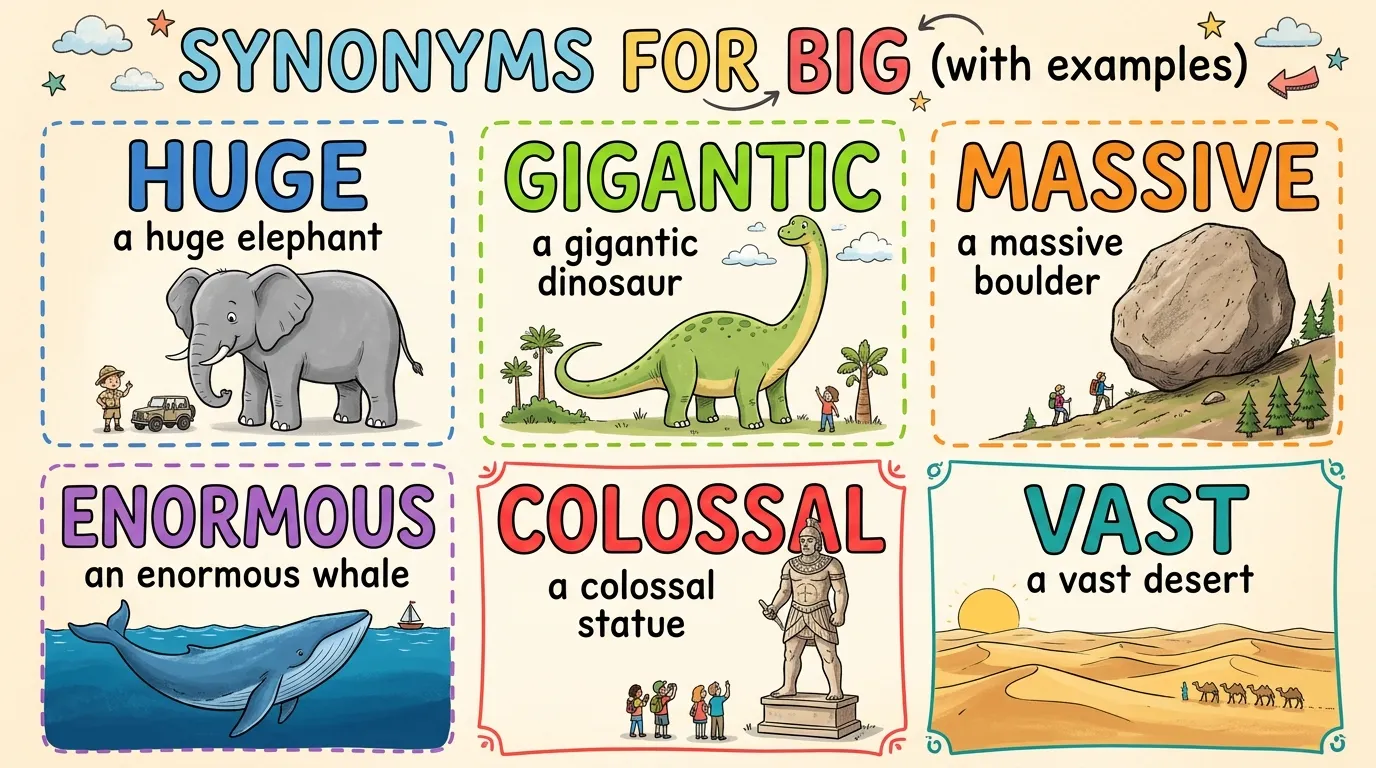
The word big is useful, but using it too often can make your writing sound repetitive. You might describe a big house, a big problem, a big success, or a big change. However, these things are not big in the same way. A house may be spacious, a problem may be serious, and a success may be remarkable. Choosing a more exact word helps readers understand what you mean. This guide explores synonyms for big with examples, grouped by size, amount, importance, and strength. You will learn what each word means, how strong it sounds, and when to use it in everyday English, schoolwork, and formal writing.
50 Synonyms for Big With Meanings and Examples
Not every synonym for big works in every sentence. Some words describe physical size, while others describe large amounts, strong feelings, or great importance. Choose the group that matches your meaning.
1. Words for Something Large in Size
Use these words when you are talking about the physical size of a person, place, object, or animal.
| Word | Simple meaning | Example sentence |
| Large | Bigger than average in size | They live in a large house near the park. |
| Huge | Very big | A huge tree stands beside our school. |
| Enormous | Extremely large | An enormous ship entered the harbor. |
| Giant | Much bigger than normal | A giant pumpkin won the garden contest. |
| Massive | Very large and heavy | Workers moved a massive stone block. |
| Immense | Extremely large in size or space | We looked across the immense desert. |
| Gigantic | Extremely big; often used for emphasis | The children built a gigantic sandcastle. |
| Colossal | So large that it is impressive | A colossal statue stood in the city square. |
| Vast | Covering a very large area | The explorers crossed a vast forest. |
| Oversized | Larger than the usual or needed size | He packed an oversized suitcase for the trip. |
Usage tip: Large is neutral and works in most situations. Huge, enormous, and gigantic sound stronger. Vast is especially useful for wide spaces, such as deserts, oceans, and areas of land.
2. Words for a Large Amount or Number
Use these words when you mean that there is a lot of something, such as money, food, work, people, or information.
| Word | Simple meaning | Example sentence |
| Considerable | A fairly large amount | The repair took a considerable amount of time. |
| Substantial | Large enough to matter | The school received a substantial donation. |
| Significant | Important or large enough to notice | The new system brought a significant improvement. |
| Abundant | More than enough; available in large amounts | Fresh water is abundant in this region. |
| Plentiful | Available in large quantities | There were plentiful supplies of food at the camp. |
| Extensive | Covering a wide range or large area | The team carried out extensive research. |
| Hefty | Large, often in weight, amount, or cost | She had to pay a hefty fee for the service. |
| Tremendous | Very great in amount or degree | The project required tremendous effort. |
| Ample | Enough or more than enough | We have ample time to finish the task. |
| Copious | A very large amount, often of a liquid or written material | The writer made copious notes during the lecture. |
Usage tip: Abundant and plentiful suggest that there is plenty of something. Substantial often describes an amount that is important or impressive. Ample means enough, not necessarily extremely large.
3. Words for Great Importance or Influence
Sometimes big does not describe physical size. It can describe an event, decision, achievement, role, or idea that matters a lot.
| Word | Simple meaning | Example sentence |
| Major | Very important or serious | Passing the final exam was a major achievement. |
| Important | Having great value or meaning | Sleep is important for good health. |
| Significant | Having a noticeable effect or meaning | The discovery was significant for medical research. |
| Crucial | Extremely important to success | Clear instructions are crucial for this task. |
| Critical | Very important, especially at a key moment | The patient received care during a critical hour. |
| Key | Most important or central | Trust is a key part of a strong friendship. |
| Principal | Main or most important | Her principal reason for joining was to learn. |
| Prominent | Important, well-known, or easy to notice | He is a prominent leader in the local community. |
| Influential | Able to affect people or decisions | The teacher became an influential voice in education. |
| Far-reaching | Having effects over a wide area or for a long time | The law brought far-reaching changes to the country. |
Usage tip: Major is a common choice for important events or problems. Crucial and critical shows that something is essential. Influential describes the power to affect others, not physical size.
4. Words for Strong Feelings, Effects, or Experiences
Use these words when big means powerful, intense, or impressive.
| Word | Simple meaning | Example sentence |
| Powerful | Having a strong effect | Her speech delivered a powerful message. |
| Intense | Very strong or extreme | The players felt intense pressure before the match. |
| Profound | Deep or having a strong effect on thought or feeling | The book had a profound effect on my views. |
| Dramatic | Sudden, striking, or very noticeable | The team made a dramatic improvement this year. |
| Overwhelming | So strong that it is hard to manage | The family received overwhelming support from neighbors. |
| Remarkable | Unusual and worth noticing | She made remarkable progress in English. |
| Extraordinary | Far beyond what is usual | The young artist showed extraordinary talent. |
| Impressive | Causing admiration | The student gave an impressive presentation. |
| Exceptional | Much better or greater than usual | He showed exceptional skill during the competition. |
| Monumental | Extremely important or difficult; often used for major events or tasks | Finishing the bridge was a monumental achievement. |
Usage tip: Powerful describes strength or effect. Profound suggests a deep effect, often on thoughts or feelings. Remarkable and impressive describe something that deserves attention or admiration.
5. Informal and Everyday Alternatives
These words are common in conversation and casual writing. Some are less suitable for formal essays or reports.
| Word | Simple meaning | Example sentence |
| Whopping | Surprisingly or unusually large | He won a whopping amount of prize money. |
| Humongous | Extremely big; informal | They ordered a humongous pizza for the party. |
| Mammoth | Extremely large or difficult | Moving the whole office was a mammoth task. |
| Mega | Very large, powerful, or impressive; informal | The town held a mega sale before the holidays. |
| Ginormous | Extremely big; playful and informal | My little brother drew a ginormous robot. |
| Bulky | Large and difficult to carry or store | The bulky box would not fit in the car. |
| Roomy | Having plenty of space inside | Their new car is roomy enough for five people. |
| Spacious | Having a lot of open space | The apartment has a spacious kitchen. |
| Grand | Impressive in size or appearance | The guests entered through a grand doorway. |
| Oversized | Bigger than the normal size | She wore an oversized jacket on the cold day. |
Usage tip: Humongous, ginormous, and mega are playful or informal. Spacious and roomy describe places or objects with plenty of usable space. Bulky often suggests that something is awkward to move.
Which Word Should You Use?
Several synonyms for big seem similar, but they do not always fit the same sentence. Here is how to choose between six common options.
Big vs. Large
Both words describe physical size. Big is more common in everyday speech and sounds natural in casual conversation. Large is slightly more formal and often fits reports, descriptions, and school writing.
- Casual: We bought a big table for the kitchen.
- More formal: The company opened a large office in the city.
Use large when you want a neutral word that sounds clear and precise. Use big when you want simple, natural conversation.
Huge vs. Enormous
Both mean very large. Huge is common and direct, while enormous often sounds a little more formal or descriptive.
- The dog has huge paws.
- An enormous crowd gathered outside the stadium.
Use huge in everyday speech. Choose enormous when you want to create a stronger picture of size.
Massive vs. Gigantic
Massive often suggests great size, weight, or solid structure. Gigantic focuses on extreme size and can sound more dramatic.
- The workers lifted a massive metal door.
- A gigantic wave crashed against the shore.
Use massive for heavy objects, buildings, or major amounts. Use gigantic when something seems unusually large.
Vast vs. Spacious
These words both relate to space, but they are not interchangeable. Vast usually describes a very large area or range. Spacious describes a place with enough open room to feel comfortable.
- The hikers explored a vast mountain region.
- The hotel room was bright and spacious.
Use vast for landscapes, areas, and subjects. Use spacious for rooms, homes, offices, and vehicles.
Major vs. Significant
Both can describe importance. Major often means one of the main or most important things. Significance suggests that something has meaning, value, or a noticeable effect.
- Education is a major concern for the community.
- The new method made a significant difference.
Use major for main events, issues, or changes. Use significant when you want to highlight the meaning or effect of something.
Substantial vs. Considerable
Both describe a fairly large amount. Substantial often suggests that the amount is large enough to be important or useful. Considerable means a large amount or degree, without always suggesting a practical benefit.
- The charity received a substantial donation.
- The journey took a considerable amount of time.
Use substantial money, support, evidence, or resources. Use considerable for time, effort, distance, or amounts when you want a neutral description.
Common Mistakes When Using Synonyms for Big
Choosing a synonym is not just about finding a stronger word. The word must fit the meaning and grammar of the sentence.
1. Using “huge” in every situation
Incorrect: The huge importance of reading is clear.
Better: The great importance of reading is clear.
Huge usually describes size or an amount in informal language. Great or significant is often more natural when discussing importance.
2. Using “spacious” for everything
Incorrect: We explored a spacious desert.
Better: We explored a vast desert.
Spacious usually describes a room, home, or other place that has plenty of usable space. Vast is better for a very large open area.
3. Confusing “massive” with “important”
Incorrect: She made a massive decision about her future.
Better: She made a major decision about her future.
Massive usually describes physical size or a very large amount. Major is more natural for an important decision.
4. Using informal words in formal writing
Too informal: The project was a humongous success.
Better: The project was a remarkable success.
Words such as humongous, ginormous, and mega work well in casual speech. In essays, reports, and job applications, choose words such as substantial, significant, or remarkable when they fit the meaning.
Antonyms of Big
An antonym is a word with the opposite meaning. The best opposite of big depends on what you are describing.
| Big-related word | Opposite | Example sentence |
| Big / large | Small | We moved from a large house to a small apartment. |
| Huge / enormous | Tiny | A tiny bird sat on the garden wall. |
| Massive | Lightweight | The lightweight bag was easy to carry. |
| Vast | Limited | The project had a limited budget. |
| Spacious | Cramped | The old room felt cramped after we added two desks. |
| Major | Minor | A minor mistake delayed the delivery. |
| Significant | Insignificant | The difference was insignificant in the final results. |
| Abundant | Scarce | Clean water is scarce in some dry regions. |
| Powerful | Weak | The weak signal made the call difficult. |
| Important | Unimportant | The small detail seemed unimportant at first. |
Remember that opposites depend on context. For example, lightweight is the opposite of heavy, not a general opposite of big. Use it when you are talking about weight.
FAQs:
1. What are the most common synonyms for big?
The most common synonyms include large, huge, enormous, massive, and gigantic. They describe physical size, but they differ in strength. Large is neutral, while enormous and gigantic are much stronger.
2. What is a formal word for big?
Large, substantial, considerable, and significant can work in formal writing. The right choice depends on the meaning. For example, use substantial for a large donation and significant for an important result.
3. What is a stronger word than big?
Enormous, immense, gigantic, and colossal are stronger than big when describing size. For an important event or task, major or monumental may be a better choice.
4. Can I use “big” in academic writing?
Yes. Big is a normal English word, but it can be too general in academic writing. Choose a more exact word, such as substantial for an amount, significant for an effect, or major for an important issue.
5. What is the difference between big and huge?
Big means large in size, amount, or importance. Huge means very big and gives the sentence more force. For example, “a big room” sounds neutral, while “a huge room” suggests that the room is extremely large.
Conclusion:
There are many useful synonyms for big, but the best word depends on what you want to describe. Use large for general size, vast for wide areas, substantial for large amounts, and major for importance. Stronger words can make your writing more vivid, but accuracy matters more than using impressive vocabulary.
