
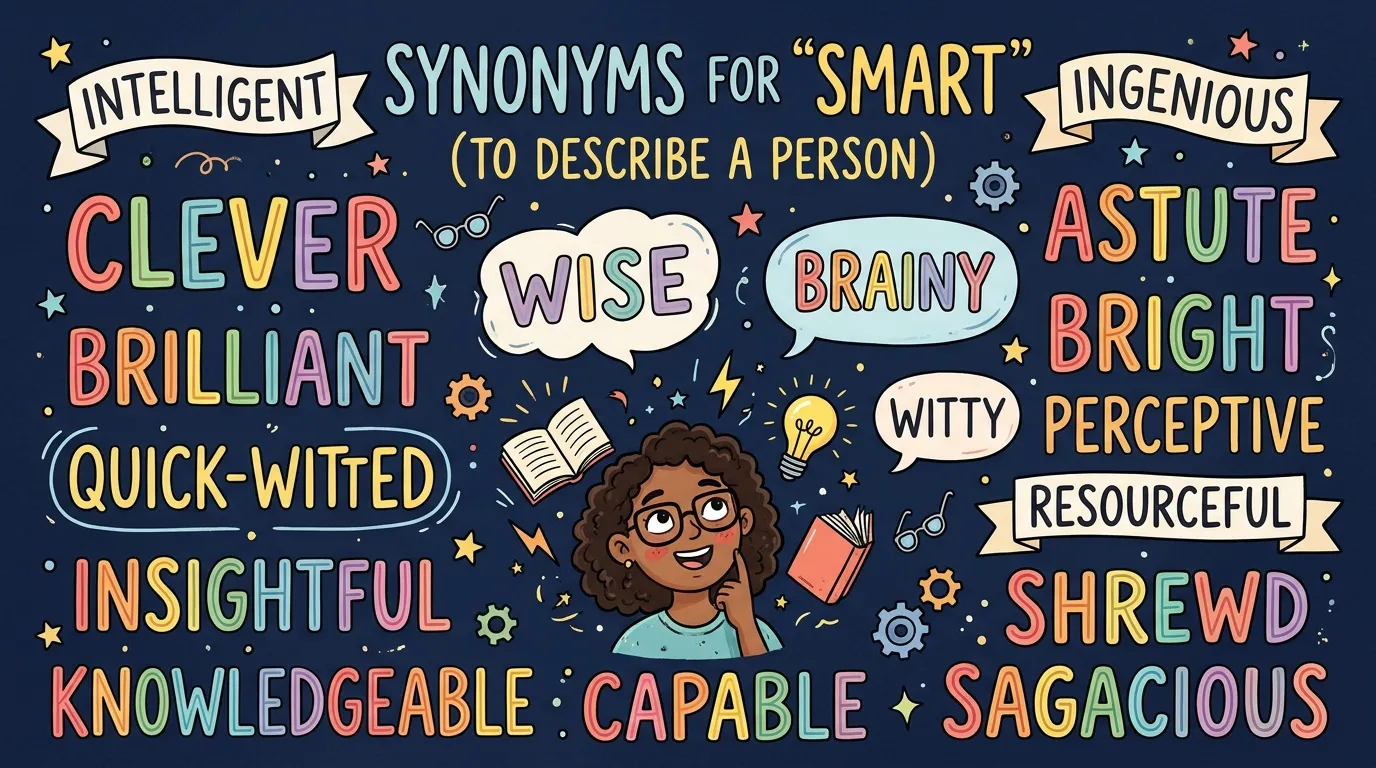
The best synonyms for smart to describe a person are intelligent, bright, clever, brilliant, sharp, wise, and knowledgeable. However, each word shows a different kind of smart. Use bright for a promising student, brilliant for someone exceptional, wise for good judgment, knowledgeable or well-read for someone who knows a lot, resourceful for practical problem-solvers, and perceptive for someone who understands people. Below are 40 synonyms for smart, grouped by type of intelligence, each with a tone label and an example sentence.
Quick Answer: 10 Best Words for a Smart Person
- Intelligent – able to learn and understand well (neutral, works anywhere)
- Bright – quick to learn (great for students and kids)
- Clever – quick at solving problems
- Brilliant – extremely intelligent or talented
- Sharp – quick to notice and understand
- Wise – shows good judgment from experience
- Knowledgeable – knows a lot about a subject
- Resourceful – good at finding solutions
- Perceptive – notices what others miss
- Gifted – has natural, unusual ability
The Smart Person Cheat Sheet
Different situations call for different words, so find yours below.
| Situation | Best words | Example |
| Recommendation letter | exceptional, intelligent, analytical | Maria is an exceptionally intelligent and analytical student. |
| Resume or cover letter | analytical, resourceful, innovative | I am a resourceful problem-solver with strong analytical skills. |
| Report card comment | bright, inquisitive, studious | Jordan is a bright, inquisitive learner who loves to ask questions. |
| Compliment to a friend | brilliant, sharp, clever | That was a brilliant idea! |
| Story character | shrewd, perceptive, quick-witted | The shrewd detective noticed the muddy boots at once. |
| Older person or mentor | wise, knowledgeable, level-headed | My grandfather is the wisest person I know. |
Synonyms for Smart by Type of Intelligence
First, ask yourself: “Smart in what way?” Then pick a word from the matching group. Tone labels show where each word fits: formal (essays, letters, reports), neutral (almost anywhere), or informal (casual speech).
1. Generally Smart
| Word | Meaning | Tone | Example |
| Intelligent | able to learn, understand, and think well | neutral / formal | She is an intelligent and thoughtful leader. |
| Clever | quick to learn and solve problems | neutral | The clever student found a shortcut to the answer. |
| Bright | quick to learn; full of promise | neutral | He is a bright kid with a big imagination. |
| Brilliant | extremely intelligent | neutral | Marie Curie was a brilliant scientist. |
| Gifted | having unusual natural ability | neutral | The school runs a program for gifted children. |
| Sharp | quick to notice and understand | informal / neutral | My boss is sharp; nothing gets past her. |
| Brainy | very smart (casual) | informal | My brainy cousin solves math puzzles for fun. |
| Witty | clever and funny with words | neutral | Our witty teacher always makes grammar fun. |
2. Book Smart (Knows a Lot)
| Word | Meaning | Tone | Example |
| Knowledgeable | knowing a lot about a subject | neutral | The museum guide was friendly and knowledgeable. |
| Well-read | having read many books | neutral | My aunt is well-read and loves to talk about novels. |
| Educated | having a good education | neutral | He is an educated man with two degrees. |
| Scholarly | serious about study and research | formal | The professor wrote a scholarly book on ancient Rome. |
| Learned | having a lot of knowledge from study (say LER-nid) | formal | The learned judge explained the law clearly. |
| Erudite | having deep and wide knowledge | formal | Her erudite lecture impressed the whole audience. |
| Intellectual | interested in ideas and serious thinking | neutral / formal | He enjoys intellectual conversations about history. |
3. Wise (Good Judgment)
| Word | Meaning | Tone | Example |
| Wise | having good judgment from experience | neutral | Ask Grandma; she always gives wise advice. |
| Sensible | making practical, reasonable choices | neutral | It was sensible of you to save some money. |
| Shrewd | clever at judging people and situations | neutral | The shrewd businesswoman spotted the deal early. |
| Astute | quick to see what matters and use it | formal | He is an astute observer of politics. |
| Discerning | able to judge quality well | formal | A discerning reader will notice the hidden clues. |
| Level-headed | calm and sensible, even under stress | neutral | Our level-headed captain kept the team calm. |
| Analytical | good at breaking problems into parts | neutral / formal | She has an analytical mind and loves data. |
4. Street Smart (Practical Intelligence)
| Word | Meaning | Tone | Example |
| Resourceful | good at finding ways to solve problems | neutral | The resourceful campers built a shelter from branches. |
| Savvy | having practical knowledge and good sense | informal / neutral | My tech-savvy niece set up my new phone in minutes. |
| Street-smart | wise about how the real world works | informal | Growing up in the city made him street-smart. |
| Practical | good at dealing with real problems | neutral | My mom is practical and always has a plan B. |
| Quick-thinking | able to think fast in a crisis | neutral | A quick-thinking nurse saved the man’s life. |
5. Creative Smart
| Word | Meaning | Tone | Example |
| Creative | full of new and original ideas | neutral | Our creative team designed the whole campaign. |
| Inventive | good at creating new things | neutral | The inventive boy built a robot from old toys. |
| Innovative | bringing new methods or ideas | neutral / formal | She is an innovative teacher who uses games in class. |
| Imaginative | having a strong imagination | neutral | The imaginative writer created a whole new world. |
| Ingenious | very clever and original | neutral | Using a coat hanger as an antenna was ingenious. |
6. Smart Students and Kids
| Word | Meaning | Tone | Example |
| Precocious | smart or skilled earlier than usual | neutral | The precocious five-year-old was already reading chapter books. |
| Studious | spending a lot of time studying | neutral | The studious girl spent her lunch break in the library. |
| High-achieving | earning top results | neutral | The program supports high-achieving students. |
| Inquisitive | eager to learn and ask questions | neutral | Inquisitive kids ask “why” a hundred times a day. |
Tone note: Precocious is usually a compliment. However, it can sometimes suggest a child who acts too grown-up.
7. People Smart (Emotional Intelligence)
| Word | Meaning | Tone | Example |
| Perceptive | noticing things others miss | neutral | A perceptive teacher noticed that Sam was upset. |
| Intuitive | understanding without needing to think hard | neutral | She has an intuitive sense of what customers want. |
| Tactful | careful to say things kindly | neutral | Our tactful manager gives feedback without hurting anyone. |
| Emotionally intelligent | good at understanding feelings | neutral / formal | Emotionally intelligent leaders listen before they speak. |
How Smart? From Smart to Genius
smart → clever → bright → intelligent → brilliant → genius
- Smart: sensible, practical, clever
- Very smart: bright, sharp, intelligent
- Extremely smart: brilliant, gifted, erudite
- Genius level: exceptional, extraordinary
Tip: Save brilliant and genius for truly outstanding people. Otherwise, they lose their power.
Words to Avoid (They Can Sound Negative)
Unfortunately, some “smart” words carry a mean or teasing tone. So, use them carefully:
- Know-it-all – someone who acts as if they know everything
- Smart aleck – someone who makes annoying, clever remarks
- Smarty-pants – a teasing word for someone who shows off
- Egghead – a teasing word for an overly academic person
- Pretentious – trying to seem smarter than you are
How to Say Someone Is Smart Without Saying “Smart”
Strong writers often show intelligence instead of naming it. For example:
- She always asks the one question nobody else thought of.
- He can explain a hard idea in a way a child understands.
- Within a week, she knew every customer by name.
- He fixed the printer with a paper clip and a rubber band.
In addition, you can use helpful phrases such as “a quick study” (learns fast), “sharp as a tack” (very smart), and “a smart cookie” (informal compliment).
Which Word Should You Use?
Smart vs. intelligent
In most cases, both mean the same. However, intelligent sounds a bit more formal, so it fits essays and letters better.
Clever vs. smart
Clever suggests quick problem-solving. However, in American English it can also sound slightly tricky, as in “a clever excuse.”
Wise vs. smart
Smart is about learning and thinking. Wise, on the other hand, comes from experience and good judgment. A young student can be smart; wisdom usually takes time.
Intelligent vs. intellectual
An intelligent person thinks well. In contrast, an intellectual person enjoys ideas, books, and debate. You can be intelligent without being an intellectual.
Shrewd vs. astute
At first, both seem to mean clever at judging situations. Shrewd can sometimes suggest a person who looks out for themselves, while astute is always positive.
Common Mistakes with Synonyms for Smart
1. Mixing up “intelligent” and “intelligible”
Intelligent means smart. Intelligible means easy to understand.
Wrong: His speech was very intelligent, so everyone could follow it.
Right: His speech was intelligible, so everyone could follow it.
2. Adding “very” to strong words
Wrong: She is very brilliant.
Right: She is brilliant. (Or: truly brilliant.)
3. Forgetting the other meaning of “smart”
“A smart suit” means a neat, stylish suit, not an intelligent one. In addition, “smart” can describe technology, as in “a smartphone.”
4. Mispronouncing “learned”
As an adjective meaning “educated,” say LER-nid: “a learned professor.” As a verb, say “lernd”: “I learned a lot.”
5. Using informal words in formal writing
Wrong: The applicant is super brainy.
Right: The applicant is exceptionally intelligent.
Practice: Choose the Best Word
Fill in each blank with: inquisitive, wise, resourceful, well-read, perceptive, brilliant
- My grandmother has lived through a lot, and she gives very __________ advice.
- The __________ scientist won a Nobel Prize for her work.
- Our __________ guide made a raft when the bridge washed away.
- He is __________ and can talk about almost any classic novel.
- The __________ child kept asking how airplanes stay up.
- A __________ friend can tell you’re sad before you say a word.
Answers: 1. wise 2. brilliant 3. resourceful 4. well-read 5. inquisitive 6. perceptive
FAQs:
What is a formal word for smart?
Intelligent, astute, erudite, and analytical all sound formal. For example, “She is an astute and analytical researcher” works well in a recommendation letter.
How do you describe a smart person in one word?
First, choose the word that matches their type of intelligence: brilliant (exceptional), wise (good judgment), knowledgeable (knows a lot), or resourceful (practical problem-solver).
What is a good word for a smart student?
For example, try bright, gifted, studious, or inquisitive. In fact, teachers often use these words in report card comments.
What is a word for someone who is smart and wise?
Astute and discerning both describe someone who is clever and has good judgment. For older, experienced people, wise is the clearest choice.
Conclusion:
“Smart” is a useful word, but the right synonym tells your reader exactly what kind of smart a person is. So, use bright for students, brilliant for exceptional minds, wise for good judgment, resourceful for problem-solvers, and perceptive for people who understand others. For more ways to praise people precisely, read our synonyms for good next. Practice task: Describe a smart person you know in three sentences, using perceptive, resourceful, and wise.
