
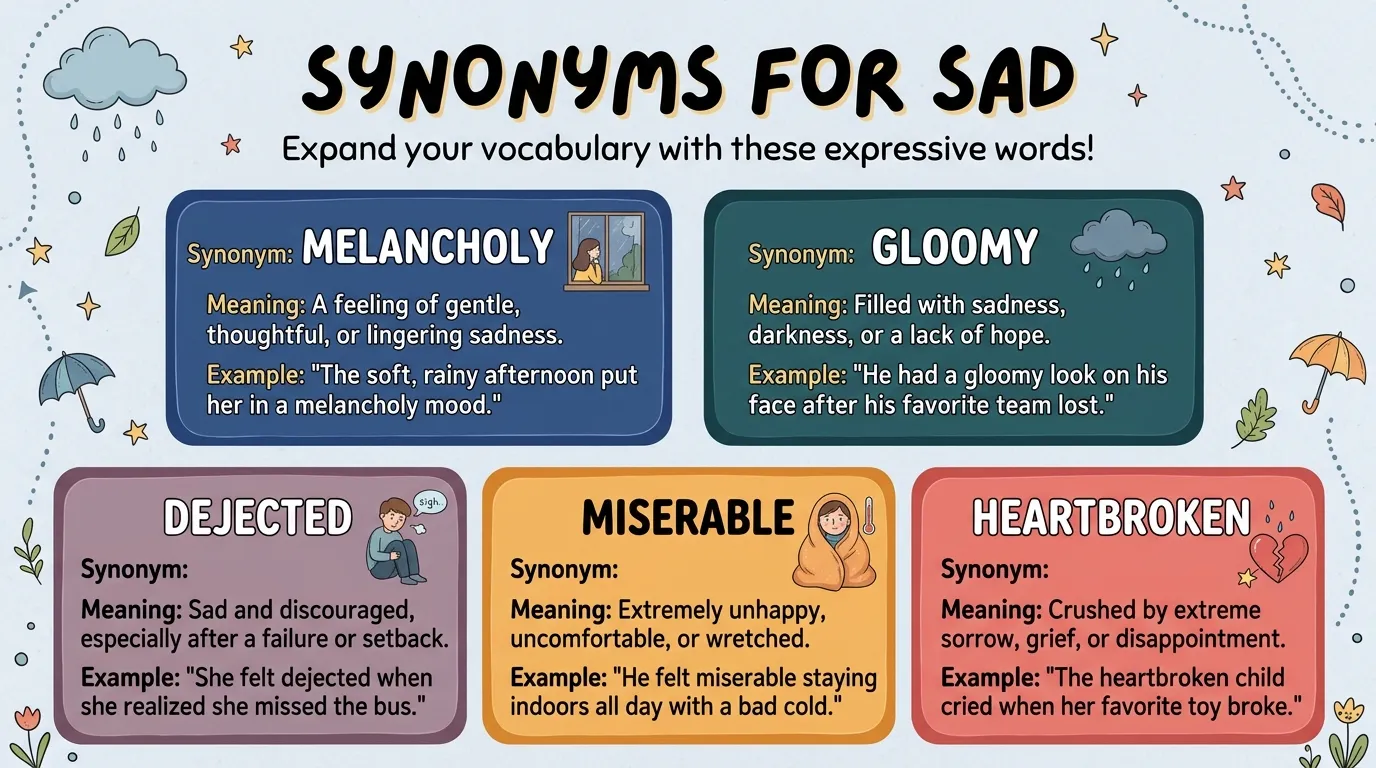
The most common synonyms for sad are unhappy, down, upset, gloomy, miserable, heartbroken, and devastated. They are not equal. Down and blue describe a mild, passing sadness, miserable is much stronger, and devastated or heartbroken describe deep pain after a loss or shock. There are also different words for a sad person (dejected) and a sad thing (heartbreaking news). Below are 36 synonyms for sad, sorted from mild to strong, each with a simple meaning and an example sentence.
Quick Answer: 10 Best Synonyms for Sad
- Unhappy – not happy; the most neutral choice
- Down – feeling a little sad (informal)
- Upset – sad and worried or hurt about something
- Gloomy – sad and without hope
- Miserable – very unhappy and uncomfortable
- Heartbroken – extremely sad, usually after losing someone or something you love
- Devastated – shocked and deeply sad
- Melancholy – a quiet, thoughtful sadness that lasts
- Depressing – making you feel sad (for things, not people)
- Sorrowful – full of deep sadness (formal)
Three Kinds of “Sad”
“Sad” has three different meanings, and each one needs different synonyms:
- A person feels sad → She feels dejected. (Sections 1–3 below)
- Something makes you sad → It was heartbreaking news. (Section 4)
- Something is poor or disappointing → That’s a sorry excuse. (Section 5)
Choosing a word from the wrong group is the most common mistake learners make, so start by asking: “Who or what is sad?”
1. Mild Synonyms for Sad (a Little Sad)
Use these for small disappointments and bad days that pass quickly.
| Word | Meaning | Tone | Example sentence |
| Down | feeling a little sad | informal | I’ve been feeling a bit down since my best friend moved away. |
| Blue | sad, often for no clear reason | informal | Rainy Sundays always make me feel blue. |
| Low | sad and lacking energy | neutral | He felt low after a long week of bad news. |
| Glum | quiet and looking unhappy | neutral | The players looked glum on the bus after the loss. |
| Unhappy | not happy or satisfied | neutral | She was unhappy with her test results. |
| Disappointed | sad because something was not as good as you hoped | neutral | The kids were disappointed when the picnic was canceled. |
2. Medium Synonyms for Sad (Clearly Sad)
These words show real sadness that the people around you would notice.
| Word | Meaning | Tone | Example sentence |
| Upset | sad and worried, hurt, or annoyed | neutral | Maya was upset that nobody remembered her birthday. |
| Sorrowful | full of sadness | formal | The widow gave a sorrowful smile at the memorial. |
| Downhearted | sad and discouraged | neutral | Don’t be downhearted; you can retake the exam in June. |
| Dejected | sad and disappointed after a failure | neutral / formal | The dejected team walked slowly off the field. |
| Gloomy | sad and without hope | neutral | Everyone was gloomy after hearing about the factory closing. |
| Melancholy | a quiet, thoughtful sadness that lasts | formal | The old photographs put him in a melancholy mood. |
| Heavy-hearted | carrying sadness inside | neutral / literary | She left her hometown heavy-hearted. |
| Crestfallen | suddenly sad and disappointed | formal | He looked crestfallen when he saw his name wasn’t on the list. |
3. Strong Synonyms for Sad (Very Sad)
Use these for deep sadness, usually after a serious loss, shock, or failure. Do not use them for small problems.
| Word | Meaning | Tone | Example sentence |
| Miserable | very unhappy and uncomfortable | neutral | I was miserable when I had the flu during the holidays. |
| Heartbroken | extremely sad after losing someone or something you love | neutral | The little boy was heartbroken when his dog died. |
| Devastated | shocked and extremely sad | neutral | The family was devastated by the fire that destroyed their home. |
| Grief-stricken | overwhelmed by sadness after a death | formal | The grief-stricken parents thanked everyone for their support. |
| Despondent | sad and without any hope | formal | After months without a job offer, he became despondent. |
| Inconsolable | so sad that no one can comfort you | formal | The toddler was inconsolable after losing her favorite toy. |
| Desolate | very sad and lonely | formal / literary | She felt desolate in the empty house after her children left. |
| Distraught | extremely upset and unable to think clearly | neutral / formal | The distraught mother searched the park for her missing son. |
Near-match note: Distraught mixes sadness with panic or worry. Desolate mixes sadness with loneliness. Grief-stricken is used almost only after a death.
Strength Scale: How Sad Is Each Word?
blue → down → unhappy → upset → gloomy → miserable → heartbroken → devastated
- Mild: blue, down, low, glum, disappointed
- Medium: unhappy, upset, dejected, gloomy, melancholy
- Strong: miserable, despondent, heartbroken
- Strongest: devastated, grief-stricken, inconsolable
Tip: Match the word to the situation. Losing a game might make you dejected. Losing a family member might leave you devastated.
4. Synonyms for Sad Things (Something That Makes You Sad)
When the sad thing is a story, song, event, or piece of news, use these words. They describe what causes the feeling.
| Word | Meaning | Tone | Example sentence |
| Depressing | making you feel sad and without hope | neutral | The documentary about plastic in the ocean was depressing. |
| Heartbreaking | causing great sadness | neutral | It was heartbreaking to watch the flood victims lose everything. |
| Tragic | extremely sad, often involving death or disaster | neutral | The bridge collapse was a tragic accident. |
| Upsetting | making you feel worried or unhappy | neutral | Some scenes in the movie may be upsetting for young children. |
| Distressing | causing worry and sadness | formal | The patient received distressing news from the doctor. |
| Regrettable | sad and something you wish had not happened | formal | The delay was regrettable but unavoidable. |
| Mournful | sounding very sad (often music or sounds) | formal | A mournful song played as the ship left the harbor. |
| Poignant | making you feel sad, often in a touching or beautiful way | formal | The movie ends with a poignant goodbye between two old friends. |
| Bleak | cold, empty, and without hope | neutral / formal | The town looked bleak in the middle of winter. |
| Somber | dark, serious, and sad | neutral | The mood at the funeral was somber. |
| Dismal | sad, dull, and depressing | neutral | It was a dismal, gray afternoon with no sunshine. |
Spelling note: Somber is the American spelling. British English uses sombre.
5. “Sad” Meaning Poor or Disappointing
In casual English, “sad” can also mean “bad” or “embarrassing,” as in “a sad excuse.” These synonyms fit that meaning:
| Word | Meaning | Tone | Example sentence |
| Pathetic | so bad that it is embarrassing | informal | That was a pathetic attempt at an apology. |
| Sorry | in a bad or poor condition | neutral | After the storm, the garden was in a sorry state. |
| Pitiful | so small or poor that people feel pity | neutral | The workers were paid a pitiful wage. |
Words to Use Instead of “Sad” in Stories (Show, Don’t Tell)
Good writers often avoid the word “sad” completely. Instead, they show sadness through actions and body language. Compare:
- Telling: Emma was sad.
- Showing: Emma pushed her dinner around her plate and didn’t say a word.
Try these phrases in your stories:
- Her shoulders slumped as she read the letter.
- His voice cracked when he tried to speak.
- Tears welled up in her eyes.
- He felt a lump in his throat.
- She stared out the window for hours.
- He pulled his hood down and walked home alone.
- Her smile didn’t reach her eyes.
Idioms That Mean Sad
These everyday expressions are common in conversation:
- Feeling blue – feeling sad. I always feel blue at the end of summer.
- Down in the dumps – sad and low (informal). He’s been down in the dumps since he lost his job.
- With a heavy heart – feeling sad about something you must do. With a heavy heart, she sold her childhood home.
- Have a long face – look sad or disappointed. Why the long face? Did something happen?
- In low spirits – feeling sad and without energy. The team was in low spirits after the defeat.
Which Word Should You Use?
Depressed vs. depressing
Depressed describes how a person feels. Depressing describes the thing that causes the feeling.
Wrong: I am depressed about my grades.
Right: I am depressed about my grades. / My grades are depressing.
Also remember that depression can describe a serious medical condition. For everyday sadness, down or low is often a better and more careful choice.
Sad vs. unhappy
They are very close. Unhappy often suggests that something is not right or not satisfying (“unhappy with the service”), while sad is more about emotion.
Heartbroken vs. devastated
Heartbroken is used when you lose someone or something you love. Devastated adds shock, as after sudden bad news or a disaster.
Melancholy vs. sad
Melancholy is a gentle, thoughtful sadness that lasts a while, often with no clear cause. It is common in literature and music.
Upset vs. sad
Upset often mixes sadness with anger or worry. “I’m upset” can mean you are hurt, annoyed, or both.
Common Mistakes with Synonyms for Sad
1. Mixing up “-ed” and “-ing” adjectives
People feel disappointed, depressed, and upset. Things are disappointing, depressing, upsetting.
2. Adding “very” to strong words
Wrong: She was very devastated.
Right: She was devastated. (Or: She was completely devastated.)
3. Using strong words for small problems
Saying “I’m devastated, they ran out of chocolate cake” sounds funny unless you are joking on purpose. Use disappointed instead.
4. “Melancholy” vs. “melancholic”
Both are adjectives, but melancholy is far more common in everyday writing: “a melancholy song.”
5. Wrong prepositions
Say sad about something, upset about (or upset with) someone, and disappointed in a person or disappointed with a result.
Practice: Choose the Best Word
Fill in each blank with: heartbroken, disappointed, gloomy, depressing, inconsolable, somber
- The weather report says it will be cold and __________ all week.
- I was a little __________ that the store was closed.
- She was __________ when her grandmother passed away.
- The news about the layoffs was really __________.
- The baby was __________ until his mother came back.
- Everyone wore black, and the mood was __________.
Answers: 1. gloomy 2. disappointed 3. heartbroken 4. depressing 5. inconsolable 6. somber
FAQs:
What is a stronger word for sad?
Miserable, heartbroken, devastated, and despondent are all much stronger than sad. Devastated is one of the strongest, because it adds a feeling of shock.
What is a formal word for sad?
Sorrowful, dejected, despondent, and melancholy sound formal and work well in essays and literature.
How do you describe sadness in writing without using “sad”?
Show it through actions and body language, such as slumped shoulders, a cracking voice, or tears welling up. You can also use precise words like crestfallen or heavy-hearted.
What is the opposite of sad?
The most common opposites are happy, cheerful, joyful, and glad. For strong sadness like devastation, a strong opposite is overjoyed.
Conclusion:
“Sad” covers everything from a slow Monday to the loss of someone you love, so the right synonym makes your meaning much clearer. Use down or blue for mild feelings, dejected or gloomy for clear sadness, and save heartbroken and devastated for truly painful moments. To learn the other side of the scale, read our synonyms for happy next. Practice task: Write three sentences about a sad moment in a story using crestfallen, gloomy, and heartbroken.
