
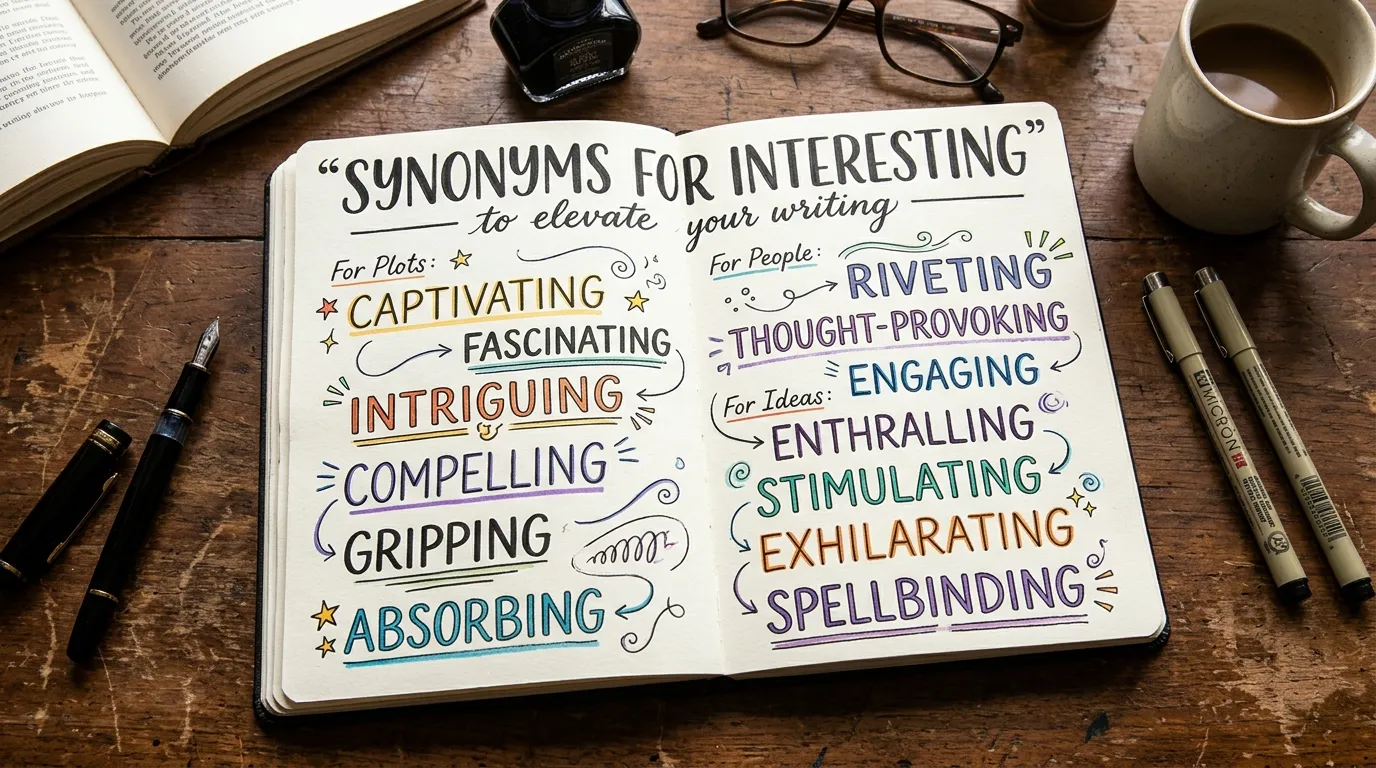
The best synonyms for interest in writing are fascinating, engaging, compelling, intriguing, thought-provoking, gripping, and insightful. Pick the one that says why something is interesting: gripping or riveting for a story you can’t put down, thought-provoking or insightful for ideas, intriguing or curious for something mysterious or unusual, and informative for facts. Below are 40 synonyms for interesting, grouped by meaning, each with a tone label and an example sentence, plus before-and-after rewrites for essays and book reports.
Quick Answer: 10 Best Synonyms for Interesting in Writing
- Fascinating – extremely interesting
- Engaging – holding your attention in a pleasant way
- Compelling – so interesting you have to pay attention
- Intriguing – interesting because it is mysterious or unusual
- Thought-provoking – making you think carefully
- Gripping – so exciting you can’t stop reading or watching
- Insightful – showing a deep, clear understanding
- Captivating – holding your attention completely
- Informative – giving useful facts
- Riveting – so exciting your attention is fixed on it
Why Teachers Circle “Interesting”
“Interesting” is one of the words English teachers mark most often in student writing. The problem is not that it’s wrong. The problem is that it doesn’t tell the reader anything. When you write “The book was interesting,” your teacher still doesn’t know if it was exciting, funny, surprising, or full of useful information.
Compare these sentences:
| Before (vague) | After (specific) |
| The book was interesting. | The book was gripping; I finished it in one night. |
| The author makes an interesting point. | The author makes a thought-provoking point about privacy. |
| The documentary was interesting. | The documentary was informative and changed how I think about recycling. |
| The main character is interesting. | The main character is complex, kind one moment and selfish the next. |
| It is an interesting idea. | It is a novel idea that no one in our class had considered. |
| The museum was interesting. | The museum was fascinating, especially the dinosaur hall. |
| She is an interesting speaker. | She is an engaging speaker who keeps the whole room laughing. |
| The results of the experiment were interesting. | The results of the experiment were unexpected. |
Writing tip: The strongest fix is often to add the reason. “The book was interesting” becomes “The book kept me reading past midnight because every chapter ended with a new mystery.”
The “Interesting + Noun” Cheat Sheet
| Instead of… | Try… |
| an interesting book | a gripping / absorbing book |
| an interesting fact | a fascinating / little-known fact |
| an interesting idea | a thought-provoking / novel idea |
| an interesting character | a complex / memorable character |
| an interesting article | an informative / insightful article |
| an interesting person | a charismatic / fascinating person |
| an interesting topic | a compelling topic |
| an interesting result | a noteworthy / unexpected result |
| an interesting story | an engaging / spellbinding story |
| an interesting movie | an entertaining / suspenseful movie |
| an interesting question | a thought-provoking question |
| an interesting place | a quirky / one-of-a-kind place |
Synonyms for Interesting by Meaning
Ask yourself: “Interesting in what way?” Then choose from the matching group. Tone labels show where each word fits: formal (essays, reports), neutral (almost anywhere), or informal (speaking and casual messages).
1. Holds Your Attention (Stories, Books, Movies, Speakers)
| Word | Meaning | Tone | Example |
| Engaging | interesting and pleasant to follow | neutral | Our history teacher has an engaging way of telling stories. |
| Captivating | holding your attention completely | neutral | The opening scene of the play was captivating. |
| Absorbing | so interesting you forget everything else | neutral | I found the mystery novel completely absorbing. |
| Gripping | exciting and impossible to stop reading or watching | neutral | The last episode of the series was gripping. |
| Riveting | so exciting your attention is fixed on it | neutral | The lawyer’s closing speech was riveting. |
| Compelling | so interesting or convincing you must pay attention | neutral / formal | The author tells a compelling story about life on a farm. |
| Fascinating | extremely interesting | neutral | It’s fascinating to learn how bees communicate. |
| Engrossing | taking all of your attention | neutral / formal | The biography was so engrossing that I missed my bus stop. |
| Enthralling | holding your attention like a spell | formal / literary | The storyteller kept the children enthralled for an hour. |
| Spellbinding | so interesting it feels like magic | literary | The magician’s spellbinding performance silenced the crowd. |
2. Interesting Ideas (Makes You Think)
| Word | Meaning | Tone | Example |
| Thought-provoking | making you think deeply | neutral / formal | The essay raises thought-provoking questions about social media. |
| Stimulating | encouraging new ideas and discussion | formal | We had a stimulating debate about school uniforms. |
| Insightful | showing a deep and clear understanding | formal | Her review offers an insightful look at the novel’s themes. |
| Illuminating | making something clearer and easier to understand | formal | The chart was illuminating; suddenly the data made sense. |
| Eye-opening | showing you something surprising that you didn’t know | neutral | Volunteering at the shelter was an eye-opening experience. |
| Informative | giving useful facts and information | neutral / formal | The museum guide was short but informative. |
3. Interesting Because It Is Unusual
| Word | Meaning | Tone | Example |
| Intriguing | interesting because it is mysterious | neutral | The letter contained an intriguing clue about the missing ring. |
| Curious | strange and interesting | neutral / formal | There is a curious old clock in the hallway that runs backward. |
| Quirky | unusual in a fun, charming way | informal / neutral | The town is full of quirky little shops. |
| Offbeat | unusual and different from normal | informal | The film has an offbeat sense of humor. |
| Novel | new and original | formal | The students came up with a novel way to reduce food waste. |
| Distinctive | easy to recognize because it is different | neutral / formal | The singer has a distinctive, husky voice. |
| Unconventional | not following the usual way | formal | The teacher used unconventional methods, like teaching math through music. |
4. Entertaining and Fun
| Word | Meaning | Tone | Example |
| Entertaining | enjoyable to watch, read, or listen to | neutral | The comedy was light but very entertaining. |
| Amusing | funny in a gentle way | neutral | Grandpa told an amusing story about his first car. |
| Lively | full of energy and interest | neutral | The class had a lively discussion about the book’s ending. |
| Colorful | full of interesting details or exciting variety | neutral | The author paints a colorful picture of 1920s New York. |
5. Exciting Stories and Events
| Word | Meaning | Tone | Example |
| Exciting | causing great interest and enthusiasm | neutral | The final chapter is the most exciting part of the book. |
| Dramatic | sudden, exciting, and full of strong emotion | neutral | The story takes a dramatic turn when the storm hits. |
| Action-packed | full of exciting events | informal / neutral | The movie is action-packed from start to finish. |
| Suspenseful | making you anxious to know what happens next | neutral | The suspenseful ending left the whole audience silent. |
6. Interesting People
| Word | Meaning | Tone | Example |
| Charismatic | having a strong, attractive personality | neutral | The charismatic coach inspired every player on the team. |
| Witty | clever and funny with words | neutral | My uncle is witty and always has a clever reply. |
| Magnetic | so interesting that people are drawn to you | neutral / literary | The actress has a magnetic presence on stage. |
7. Interesting for Academic Writing
| Word | Meaning | Tone | Example |
| Noteworthy | important or interesting enough to mention | formal | One noteworthy result was the drop in test anxiety. |
| Worthwhile | worth the time and effort | neutral / formal | Reading the original letters was a worthwhile part of the research. |
| Instructive | teaching you something useful | formal | The failed experiment was instructive for the whole team. |
8. Informal Words for Interesting
Fine in conversation and texts, but avoid them in essays:
| Word | Meaning | Tone | Example |
| Cool | interesting or impressive | informal | That’s a cool fact about octopuses. |
| Neat | interesting or clever | informal | What a neat idea for a birthday present! |
| Fun | enjoyable and interesting | informal | The science fair was really fun this year. |
How Strong Is Each Word? From Mild to Very Strong
okay → interesting → engaging → fascinating → captivating → riveting
- Mild: okay, fine, informative
- Medium: interesting, engaging, entertaining
- Strong: fascinating, compelling, gripping
- Very strong: riveting, enthralling, spellbinding
Tip: Use the strongest words only when they are true. If a book was “okay,” calling it riveting will make your review sound fake.
Useful Phrases for Book Reports and Essays
These sentence starters help you say why something is interesting:
- The author offers an insightful look at…
- One of the most compelling arguments in the article is…
- The story becomes gripping when…
- A noteworthy detail in the text is…
- The novel raises thought-provoking questions about…
- What makes the main character so memorable is…
Which Word Should You Use?
Interesting vs. interested
Interesting describes the thing. Interest describes how a person feels.
Wrong: I am interested in science.
Right: I am interested in science. / Science is interesting.
Fascinating vs. interesting
Fascinating is much stronger. Use it when something holds your attention completely, not just a little.
Intriguing vs. interesting
Intriguing adds mystery. An intriguing clue makes you want to find out more.
Compelling vs. convincing
A compelling story holds your attention. A convincing argument makes you believe it. A compelling argument does both.
Curious: two meanings
“A curious child” wants to learn. “A curious noise” is strange. Make sure your sentence shows which one you mean.
Common Mistakes with Synonyms for Interesting
1. Mixing up -ed and -ing
People feel interested, fascinated, intrigued. Things are interesting, fascinating, intriguing.
2. Adding “very” to strong words
Wrong: The film was very fascinating.
Right: The film was fascinating. (Or: absolutely fascinating.)
3. Using filler phrases
Phrases like “It is interesting to see that…” add words without adding meaning. Just state the fact: “Surprisingly, the smallest team won.”
4. Choosing a word that doesn’t fit the thing
Riveting and gripping fit stories and events, not facts. Say “a fascinating fact,” not “a gripping fact.”
5. Using informal words in essays
Wrong: The author has a cool point about technology.
Right: The author makes a thought-provoking point about technology.
Practice: Choose the Best Word
Fill in each blank with: suspenseful, informative, quirky, witty, thought-provoking, gripping
- The article on healthy sleep habits was short but __________.
- The last ten minutes of the thriller were so __________ that I held my breath.
- Our class discussed a __________ question: should robots have rights?
- The café is __________, with mismatched chairs and a pet parrot.
- The comedian gave a __________ answer to every question.
- I couldn’t put down the __________ adventure novel.
Answers: 1. informative 2. suspenseful 3. thought-provoking 4. quirky 5. witty 6. gripping
FAQs:
What is a better word for “interesting” in an essay?
Use a word that explains why: compelling or thought-provoking for arguments, insightful for analysis, informative for facts, and noteworthy for important details.
What is a stronger word for interesting?
Fascinating, captivating, riveting, and enthralling are all much stronger. Riveting and enthralling suggest you couldn’t look away.
How do I describe a book without saying “interesting”?
Say what the book made you feel or do: gripping, suspenseful, thought-provoking, or entertaining. Then add a reason, such as a twist you didn’t expect or a character you won’t forget.
What is the opposite of interesting?
The most common opposites are boring, dull, and tedious. Tedious is the most formal and means boring because it is too long or repetitive.
Conclusion:
“Interesting” is a safe word, but strong writers replace it with a word that shows why. Use gripping and suspenseful for stories, thought-provoking and insightful for ideas, intriguing for mysteries, and informative for facts. For more ways to make your writing precise, read our synonyms for good next. Practice task: Write two sentences about the last book or movie you enjoyed, using gripping and thought-provoking.
