
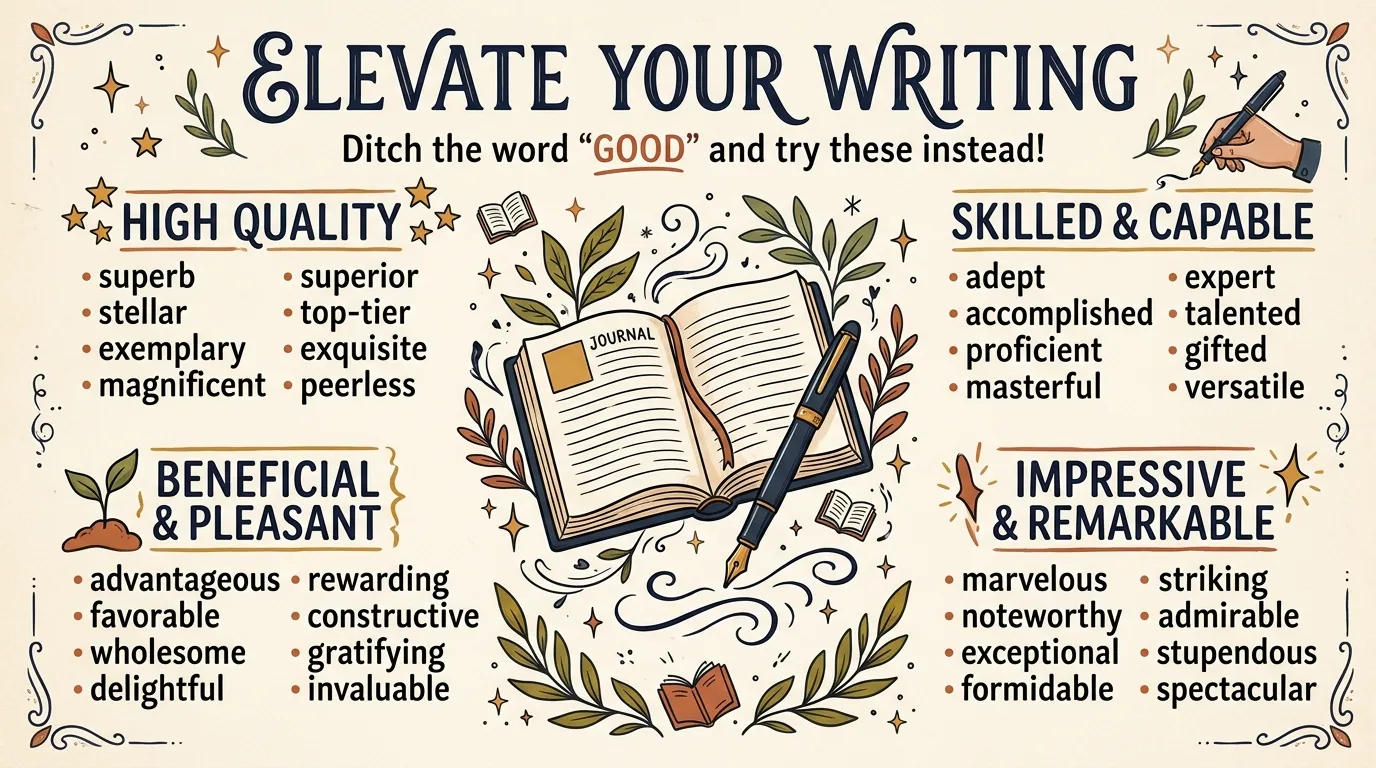
The best synonym for good depends on what “good” means in your sentence. For quality, use excellent or impressive. For a person’s skill, use skilled or talented. For something that helps, use beneficial or effective. For a kind person, use kind or generous. For the right choice, use suitable or ideal. This guide gives you 40 synonyms for good, grouped by meaning, with a tone label and an example sentence for each, so your writing sounds clear and specific instead of vague.
Why “Good” Weakens Your Writing
“Good” is not wrong. The problem is that it is too general. When a teacher reads “The book was good,” they still don’t know why. Was it exciting? Well written? Useful? A more precise word answers that question for the reader.
Here is the difference one word can make:
| Before (vague) | After (precise) |
| The movie had a good ending. | The movie had a satisfying ending. |
| She is good at math. | She is skilled at math. |
| Exercise is good for your health. | Exercise is beneficial for your health. |
| He gave a good reason. | He gave a convincing reason. |
| This is a good place for a picnic. | This is an ideal place for a picnic. |
| My grandmother is a good person. | My grandmother is a generous person. |
| The team gave a good performance. | The team gave an impressive performance. |
| Fruit is a good snack for kids. | Fruit is a nutritious snack for kids. |
Synonyms for Good by Meaning
Before you choose a word, ask yourself: “Good in what way?” Then pick from the matching group below. Tone labels show where each word fits best: formal (essays, reports, emails to teachers or bosses), neutral (almost anywhere), or informal (speaking and casual messages).
1. Good Quality
| Word | Meaning | Tone | Example |
| Excellent | extremely good | neutral / formal | Your essay shows excellent research. |
| Outstanding | much better than most others | neutral / formal | She received an award for outstanding work in science. |
| Superb | of the highest quality | neutral | The hotel serves a superb breakfast. |
| Impressive | good enough to earn admiration | neutral | The new library has an impressive collection of books. |
| Exceptional | unusually good, rare | formal | The school offers scholarships to students with exceptional talent. |
| High-quality | made or done to a high standard | neutral / formal | The company uses high-quality materials in its shoes. |
| Solid | reliable and good, without being amazing | informal / neutral | He has a solid plan for his science project. |
Tone note: Solid means good and dependable, not brilliant. Use it when you want to sound fair, not full of praise.
2. Good at Something (Skill)
| Word | Meaning | Tone | Example |
| Skilled | having the ability to do something well | neutral | The factory needs skilled workers. |
| Talented | having a natural ability | neutral | My brother is a talented guitar player. |
| Capable | able to do something well | neutral | She is a capable leader who stays calm under pressure. |
| Competent | able to do a job well enough | formal | He is a competent driver, but he still gets nervous on highways. |
| Accomplished | highly trained and successful | formal | The concert featured an accomplished violinist. |
| Proficient | skilled through practice and training | formal | Applicants must be proficient in English. |
Near-match note: Competent means “good enough,” not “excellent.” Writing “my teacher is competent” can sound like weak praise. Use skilled or accomplished when you want to praise someone.
3. Good as a Person (Moral Character)
| Word | Meaning | Tone | Example |
| Kind | caring and friendly to others | neutral | A kind stranger helped me carry my bags. |
| Honest | always telling the truth | neutral | We need an honest leader we can trust. |
| Generous | happy to give time, money, or help | neutral | Our neighbor is generous with his tools. |
| Decent | honest, fair, and respectful | neutral / informal | He is a decent man who treats everyone fairly. |
| Caring | showing concern for others | neutral | The nurses on the ward were patient and caring. |
| Virtuous | having high moral standards | formal | The story’s hero is brave and virtuous. |
4. Good for Someone or Something (Helpful or Healthy)
| Word | Meaning | Tone | Example |
| Beneficial | having a good effect | formal | Regular sleep is beneficial for memory. |
| Helpful | making a job easier | neutral | The librarian gave me some helpful advice. |
| Useful | able to be used for a practical purpose | neutral | A dictionary app is useful when you travel. |
| Valuable | very useful or important | neutral | The internship gave me valuable experience. |
| Effective | producing the result you want | neutral / formal | Flash cards are an effective way to learn vocabulary. |
| Advantageous | giving you a benefit or advantage | formal | Speaking two languages is advantageous in many jobs. |
| Healthy | good for your body | neutral | Walking to school is a healthy habit. |
| Nutritious | full of things your body needs | neutral | Lentils are cheap and nutritious. |
5. Good and Enjoyable
| Word | Meaning | Tone | Example |
| Pleasant | nice and enjoyable | neutral | We had a pleasant walk along the river. |
| Enjoyable | giving you pleasure | neutral | The field trip was educational and enjoyable. |
| Satisfying | making you feel pleased or complete | neutral | Solving a hard puzzle is very satisfying. |
6. Good for the Situation (Right or Suitable)
| Word | Meaning | Tone | Example |
| Suitable | right for a purpose or person | neutral / formal | This movie is not suitable for young children. |
| Appropriate | correct for a situation | formal | Jeans are not appropriate for a job interview. |
| Fitting | right for the occasion | formal | The new park is a fitting tribute to the town’s founder. |
| Ideal | the best possible for a purpose | neutral | Saturday morning is the ideal time to clean the house. |
7. Good Reason or Argument
| Word | Meaning | Tone | Example |
| Convincing | making you believe something is true | neutral | The lawyer presented convincing evidence. |
| Persuasive | able to make people agree | neutral / formal | Her persuasive essay won first prize. |
| Valid | logical and acceptable | formal | You make a valid point about school fees. |
| Sound | based on good judgment, reliable | formal | My uncle gave me sound advice about saving money. |
8. Good Behavior
| Word | Meaning | Tone | Example |
| Well-behaved | behaving in a calm, polite way | neutral | The children were well-behaved during the long flight. |
| Polite | having good manners | neutral | It is polite to say thank you after a meal. |
How Strong Is Each Word? From Mild to Very Strong
Some words are only a little better than “good.” Others are much stronger.
fine → good → great → excellent → outstanding → exceptional
- Mild: fine, solid
- Medium: good, pleasant, effective
- Strong: excellent, impressive, superb
- Very strong: outstanding, exceptional
Tip: Match the word to the facts. If a test score was 72%, “outstanding” sounds false. “Solid” or “good” sounds honest.
Better Words for “Very Good”
Writers often type “very good” when one strong word would work better. Try these from the tables above:
- very good food → superb food
- a very good student → an exceptional student
- very good work → excellent work
- a very good result → an outstanding result
- a very good effort → an impressive effort
Formal Synonyms for Good (for Essays and Reports)
In academic writing, these words from the tables sound clear and professional:
- Beneficial – A balanced diet is beneficial for students’ concentration.
- Effective – Group study can be an effective revision method.
- Valid – The author raises a valid concern about online privacy.
- Appropriate – The survey used an appropriate sample size.
- Exceptional – The results were exceptional compared with last year’s.
- Proficient – Most participants were proficient in basic computer skills.
Informal Ways to Say Good (for Speaking and Messages)
In conversation, people often use great, awesome, cool, or not bad. These are fine with friends, but avoid them in essays:
- “The party was awesome!” (speaking) → “The party was enjoyable.” (writing)
- “Your plan is pretty cool.” (speaking) → “Your plan is effective.” (writing)
Which Word Should You Use?
Good vs. well
Good is an adjective (it describes a noun). Well is usually an adverb (it describes a verb).
Wrong: She sings well.
Right: She sings well. / She is a good singer.
Excellent vs. great
Both mean very good, but great sounds more casual. In essays and reports, excellent is the safer choice.
Skilled vs. talented
Talented suggests natural ability. Skilled suggests ability gained through practice. A child can be a talented artist; a mechanic with 20 years of experience is skilled.
Beneficial vs. helpful
Helpful usually describes people, advice, or tools that make a task easier. Beneficial describes effects, often on health or results. “A helpful teacher,” but “a beneficial habit.”
Kind vs. nice
Nice is very general, so it has the same problem as good. Kind is more specific: it means caring about others. In writing, prefer kind, generous, or friendly over nice.
Common Mistakes When Replacing “Good”
1. Adding “very” to strong words
Wrong: The meal was very excellent.
Right: The meal was excellent.
Words like excellent, outstanding, and superb are already strong. Do not add very.
2. Using a word with the wrong meaning
Wrong: Vegetables are good for your body.
Right: Vegetables are healthy for your body.
Always ask “good in what way?” before you swap the word.
3. Mixing up “healthy” and “healthful”
In everyday writing, healthy is used for both people and food (“a healthy meal”). You do not need health unless your teacher asks for it.
4. Wrong prepositions
We say good at math, skilled in (or skilled at) carpentry, beneficial for (or beneficial to) health, and suitable for children. Do not write “skilled for math” or “suitable for children.”
5. Replacing every “good”
“Good” is still a fine word in simple sentences like “Good morning” or “Have a good day.” Replace it only when a more precise word makes your meaning clearer.
Practice: Choose the Better Word
Fill in each blank with the best word: nutritious, proficient, convincing, appropriate, generous, satisfying
- Brown rice is more __________ than white bread.
- To work as a translator, you must be __________ in at least two languages.
- The detective found __________ proof that the butler was innocent.
- Shorts and flip-flops are not __________ clothes for a wedding.
- My aunt is very __________; she always shares her food with neighbors.
- Finishing a marathon must feel incredibly __________.
Answers: 1. nutritious 2. proficient 3. convincing 4. appropriate 5. generous 6. satisfying
FAQs:
What can I use instead of “good” in an essay?
First decide what “good” means in your sentence. For quality, use excellent or impressive. For effects, use beneficial or effective. For arguments, use convincing or valid. For people, use kind, honest, or skilled.
What is a stronger word for good?
Excellent, outstanding, superb, and exceptional are all much stronger than good. Exceptional is the strongest, because it means unusually good.
Is “great” a formal word?
Great is common and not wrong, but it sounds conversational. In academic writing, words like excellent, significant, or impressive usually sound more professional.
What is a formal way to say “very good”?
Use a single strong adjective such as excellent, outstanding, or exceptional. For example, “The results were exceptional” sounds more formal than “The results were very good.”
Conclusion:
“Good” is a useful word, but specific synonyms make your writing clearer and more convincing. Ask yourself “good in what way?” and then choose from quality, skill, character, benefit, enjoyment, suitability, argument, or behavior. If you also overuse “very,” try our guide to words to use instead of very next. Practice task: Rewrite these three sentences with better words: “It was a good trip.” “She is good at science.” “Sleep is good for you.”
