
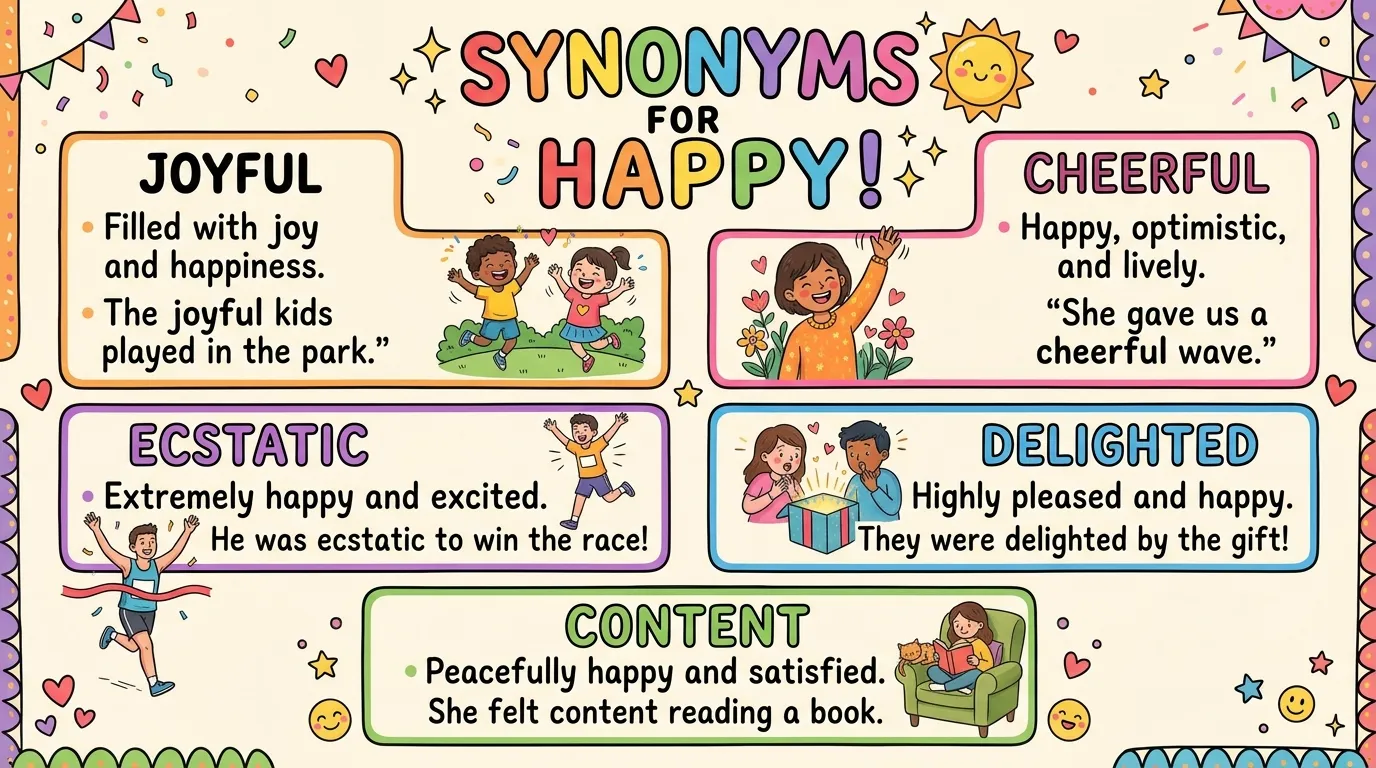
Happiness is a common feeling, but the word happy does not always express exactly what you mean. You might feel pleased about good news, delighted by a gift, cheerful on a sunny day, or thrilled about a big achievement. Each feeling has a slightly different meaning. Learning synonyms for happy with examples can help you choose the right word for school essays, IELTS writing, everyday conversations, emails, and creative writing. This guide explains 60 useful alternatives, from simple words to stronger and more formal expressions. You will also learn how to use them naturally, avoid common mistakes, and choose the best word for each situation.
60 Synonyms for Happy With Meanings and Examples
Not every synonym for happy means exactly the same thing. Some describe a quiet feeling of satisfaction, while others show great excitement or joy. The following groups will help you understand these differences.
1. Simple and Everyday Synonyms for Happy
These words are easy to understand and useful in daily conversations, schoolwork, and simple writing.
| Synonym | Simple meaning | Example sentence |
| Glad | Feeling pleased about something | I am glad you came to my birthday party. |
| Cheerful | Showing a happy and positive mood | Our teacher always has a cheerful smile. |
| Pleased | Feeling satisfied or happy with something | My parents were pleased with my exam results. |
| Joyful | Feeling or showing great happiness | The children had a joyful afternoon at the park. |
| Merry | Happy and full of fun | Everyone was merry during the holiday celebration. |
| Jolly | Cheerful, friendly, and full of energy | Our jolly neighbor makes everyone laugh. |
| Bright | Looking or feeling positive and cheerful | She greeted us with a bright smile. |
| Upbeat | Positive and hopeful | He stayed upbeat even after losing the match. |
| Lighthearted | Free from worry or sadness | We had a lighthearted conversation after dinner. |
| Content | Happy with what you have | She feels content with her simple life. |
Learning tip: Use glad for everyday situations, cheerful for someone’s general mood, and content when someone feels satisfied without needing anything more.
2. Strong Synonyms for Happy: Deep Joy and Excitement
These words express stronger feelings than ordinary happiness. They work well when something wonderful or important happens.
| Synonym | Simple meaning | Example sentence |
| Delighted | Very pleased and happy | I was delighted to receive your invitation. |
| Thrilled | Extremely excited and happy | She was thrilled to win the science competition. |
| Elated | Extremely happy because of success | The players were elated after winning the final. |
| Overjoyed | Filled with great joy | His family was overjoyed when he returned home. |
| Ecstatic | Feeling overwhelming happiness | The fans were ecstatic when their team scored. |
| Exhilarated | Very excited and full of energy | I felt exhilarated after my first mountain hike. |
| Jubilant | Showing great happiness after a victory | The jubilant crowd celebrated the team’s success. |
| Blissful | Extremely peaceful and happy | They enjoyed a blissful afternoon beside the lake. |
| Euphoric | Experiencing an intense feeling of happiness | She felt euphoric after reaching her lifelong goal. |
| Radiant | Showing happiness through your face or appearance | He looked radiant on his wedding day. |
Learning tip: Delighted and thrilled are useful in everyday speech. Elated, jubilant, and euphoric are stronger choices for special events and formal or descriptive writing.
3. Synonyms for Happy in Formal and Academic Writing
These words can improve essays, reports, professional messages, and IELTS responses. However, choose them only when they fit the meaning.
| Synonym | Simple meaning | Example sentence |
| Satisfied | Feeling that something is good enough | The customer was satisfied with the service. |
| Gratified | Pleased because something went well | The teacher was gratified by her students’ progress. |
| Fulfilled | Happy because life feels meaningful | He feels fulfilled by helping young learners. |
| Optimistic | Expecting good things to happen | She remains optimistic about her future. |
| Appreciative | Feeling thankful for something | We are appreciative of your continued support. |
| Complacent | Too satisfied with your situation to try harder | The team became complacent after an easy victory. |
| Buoyant | Cheerful and hopeful despite difficulties | Her buoyant attitude helped the group stay positive. |
| Serene | Calm, peaceful, and free from worry | He felt serene while sitting beside the quiet lake. |
| At ease | Comfortable and free from nervousness | The new student felt at ease with her classmates. |
| In high spirits | Feeling especially cheerful and energetic | Everyone was in high spirits before the school trip. |
Important: Some of these are near-matches rather than exact synonyms. Optimistic describes hope for the future, not necessarily present happiness. Appreciative describes gratitude, while serene describes peacefulness. Complacent can have a negative meaning, so do not use it as a simple replacement for happy.
4. Synonyms for Happy in Relationships and Personal Life
These words are useful when describing friendships, family relationships, achievements, and personal experiences.
| Synonym | Simple meaning | Example sentence |
| Warmhearted | Kind and friendly toward others | Her warmhearted nature makes people feel welcome. |
| Affectionate | Showing love and care | The affectionate couple enjoyed a quiet evening together. |
| Grateful | Feeling thankful | I am grateful to have such supportive friends. |
| Thankful | Feeling pleased because of someone’s kindness | She was thankful for her brother’s help. |
| Blessed | Feeling fortunate and thankful | We feel blessed to have a loving family. |
| Hopeful | Believing that something good may happen | The students are hopeful about their results. |
| Peaceful | Calm and free from trouble | I feel peaceful when I spend time in nature. |
| Satisfied | Happy with the result or situation | She was satisfied with her final project. |
| Carefree | Free from worries or responsibilities | The children spent a carefree day at the beach. |
| Fulfilled | Feeling that your life or actions have meaning | Volunteering makes him feel fulfilled. |
These words describe different sides of happiness. For example, grateful focuses on thankfulness, while carefree describes a lack of worry. Use them when you want to explain why someone feels happy.
5. Creative and Descriptive Synonyms for Happy
Writers can use these words to make stories, descriptions, and personal writing more interesting.
| Synonym | Simple meaning | Example sentence |
| Beaming | Showing happiness through a big smile | The little girl was beaming after opening her present. |
| Glowing | Looking healthy and happy | Her face was glowing with excitement. |
| Sparkling | Showing energy and happiness | His sparkling eyes revealed his excitement. |
| Gleeful | Showing playful happiness | The gleeful children ran toward the playground. |
| Exuberant | Extremely lively and enthusiastic | The exuberant audience welcomed the performers. |
| Carefree | Relaxed and without worries | We enjoyed a carefree weekend in the countryside. |
| Sunny | Cheerful and pleasant | She has a sunny personality that lifts everyone’s mood. |
| Festive | Happy and suitable for a celebration | The festive atmosphere made everyone smile. |
| Radiant | Clearly showing joy or pleasure | Her radiant expression made the whole family smile. |
| Mirthful | Full of laughter and amusement | Their mirthful conversation continued late into the evening. |
Writing tip: Use descriptive words such as beaming, glowing, and radiant to show happiness instead of simply telling readers that someone is happy.
Which Word Should You Use?
Many synonyms for happy look similar, but they are not always interchangeable. The best choice depends on the strength of the feeling, the situation, and the tone of your sentence.
1. Happy vs. Glad
Both words describe pleasure, but happy is more general. You can use it for feelings, situations, and long-term moods. Glad usually describes a positive reaction to something specific.
- Happy: I am happy with my new job.
- Glad: I am glad you found your lost wallet.
Use glad in everyday conversations and friendly messages.
2. Happy vs. Pleased
Pleased often suggests that something met your expectations or gave you satisfaction. It sounds slightly more formal than happy.
- Happy: She is happy with her new house.
- Pleased: The manager was pleased with the team’s performance.
Use pleased in work emails, reports, and polite conversations.
3. Happy vs. Cheerful
Happy describes a feeling. Cheerful often describes someone’s usual personality, mood, or behavior.
- Happy: I feel happy about my results.
- Cheerful: My cheerful friend always makes me smile.
Use cheerful when describing a person’s positive attitude or a pleasant atmosphere.
4. Happy vs. Delighted
Delighted is stronger than happy. It expresses great pleasure, often because of good news, a gift, an invitation, or a successful event.
- Happy: I am happy to meet you.
- Delighted: I am delighted to receive your invitation.
Use delighted in polite conversations, professional emails, and situations where you want to show extra excitement.
5. Happy vs. Content
Content means feeling satisfied with what you already have. It does not usually suggest excitement or intense joy.
- Happy: He is happy about his promotion.
- Content: He is content with his simple lifestyle.
Use content when describing quiet satisfaction and inner peace.
6. Happy vs. Thrilled
Thrilled expresses very strong excitement. It is often used for surprising or exciting news and special experiences.
- Happy: I am happy about my holiday.
- Thrilled: I am thrilled to visit my favorite country.
Use thrilled in informal conversations and personal writing when ordinary happiness is not strong enough.
Quick rule: Use glad for a positive reaction, pleased for satisfaction, cheerful for a positive mood, delighted for strong pleasure, content for quiet satisfaction, and thrilled for great excitement.
Common Mistakes When Using Synonyms for Happy
Even advanced English learners sometimes use similar words incorrectly. Here are four mistakes to avoid.
1. Using Optimistic as a Direct Replacement for Happy
Incorrect: I am optimistic because I received a birthday gift.
Better: I am delighted because I received a birthday gift.
Why? Optimistic means expecting good things in the future. It does not directly describe happiness about something that has already happened.
2. Confusing Content with Excited
Incorrect: The children were content when they saw the amusement park.
Better: The children were thrilled when they saw the amusement park.
Why? Content describes calm satisfaction. Thrilled expresses strong excitement.
3. Using Complacent as a Positive Word
Incorrect: She was complacent about winning the award.
Better: She was delighted about winning the award.
Why? Complacent often suggests being too satisfied and not making enough effort. It can sound negative.
4. Using Every Synonym in the Same Situation
Incorrect: I was ecstatic to receive a small thank-you note.
Better: I was pleased to receive a small thank-you note.
Why? Ecstatic is extremely strong. Match the strength of the word to the situation.
Antonyms of Happy
An antonym is a word with the opposite meaning. Learning opposites can help you describe feelings more clearly.
| Antonym | Simple meaning | Example sentence |
| Sad | Feeling unhappy | She felt sad when her friend moved away. |
| Unhappy | Not feeling happy | He was unhappy with the final result. |
| Miserable | Extremely unhappy | The children felt miserable in the cold rain. |
| Depressed | Feeling deeply sad or low | He felt depressed after several difficult weeks. |
| Gloomy | Dark, sad, or without hope | The gloomy weather affected everyone’s mood. |
| Disappointed | Unhappy because something did not happen as expected | I was disappointed when the event was canceled. |
| Sorrowful | Full of sadness | She gave a sorrowful smile as she said goodbye. |
| Dejected | Feeling low after failure or disappointment | The dejected player sat quietly after the match. |
| Melancholy | A quiet or thoughtful sadness | A feeling of melancholy came over him as he remembered his childhood. |
| Heartbroken | Extremely sad because of loss or emotional pain | She was heartbroken when her best friend moved abroad. |
Remember: Sad and unhappy are general opposites of happy. Words such as heartbroken and miserable express much stronger feelings.
Practice: Use These Synonyms in Your Own Sentences
The best way to remember new vocabulary is to use it. Try these short exercises.
Exercise 1: Choose the best synonym.
- I was ______ when I heard that I had passed my exam. (thrilled / gloomy)
- My grandmother is always ______ and smiles at everyone. (cheerful / dejected)
- He feels ______ with his simple and peaceful life. (content / ecstatic)
- We were ______ to receive your kind invitation. (delighted / miserable)
- She remained ______ about finding a new job. (optimistic / heartbroken)
Answers: 1. Thrilled, 2. Cheerful, 3. Content, 4. Delighted, 5. Optimistic.
Exercise 2: Improve these sentences.
Replace the word happy with a more suitable synonym.
- I was happy when I won the competition.
- She is happy with her exam results.
- My father is always happy and friendly.
- We were happy to see our old teacher.
- He is happy with his peaceful life.
Possible answers: 1. Thrilled, 2. Pleased, 3. Cheerful, 4. Delighted, 5. Content.
There can be more than one correct answer. Think about the meaning you want to express before choosing a word.
FAQs:
1. What are the 10 best synonyms for happy?
Ten useful synonyms are glad, cheerful, pleased, joyful, delighted, thrilled, content, satisfied, elated, and overjoyed. Each expresses a different level or type of happiness. Choose the one that best matches your situation.
2. What is a stronger word for happy?
Words such as ecstatic, overjoyed, elated, and thrilled express stronger feelings than happy. Use ecstatic for overwhelming joy and thrilled for great excitement about something special.
3. What is a formal synonym for happy?
Satisfied, gratified, and pleased are useful in formal writing. For example, “The customer was satisfied with the service” sounds suitable for a business report.
4. What is a simple synonym for happy for students?
Glad, pleased, cheerful, and joyful are simple alternatives that students can use in everyday English. For example, “I am glad to see my friends” is a natural sentence.
5. What is the difference between happy, joyful, and delighted?
Happy is a general word for feeling good. Joyful expresses a strong feeling of joy, while delighted means very pleased about something. For example, you may feel happy every day but delighted when you receive wonderful news.
Conclusion:
Learning synonyms for happy with examples helps you express your feelings more clearly and make your English more interesting. Remember that glad, pleased, content, delighted, and ecstatic have different levels and meanings. Choose words that match your situation instead of replacing happy without thinking. For practice, write three sentences using cheerful, delighted, and content. Then try replacing happy in three sentences of your own with stronger or more precise words.
